For my last review, I took a deep dive into Hale ‘I‘iwi – Songs from the Rainforest by Joanne Lazzaro — a lush, immersive journey shaped by the sounds and spirit of Hawaii’s natural world. If you missed it, you can read that one here: Hale ‘I‘iwi – Songs from the Rainforest.
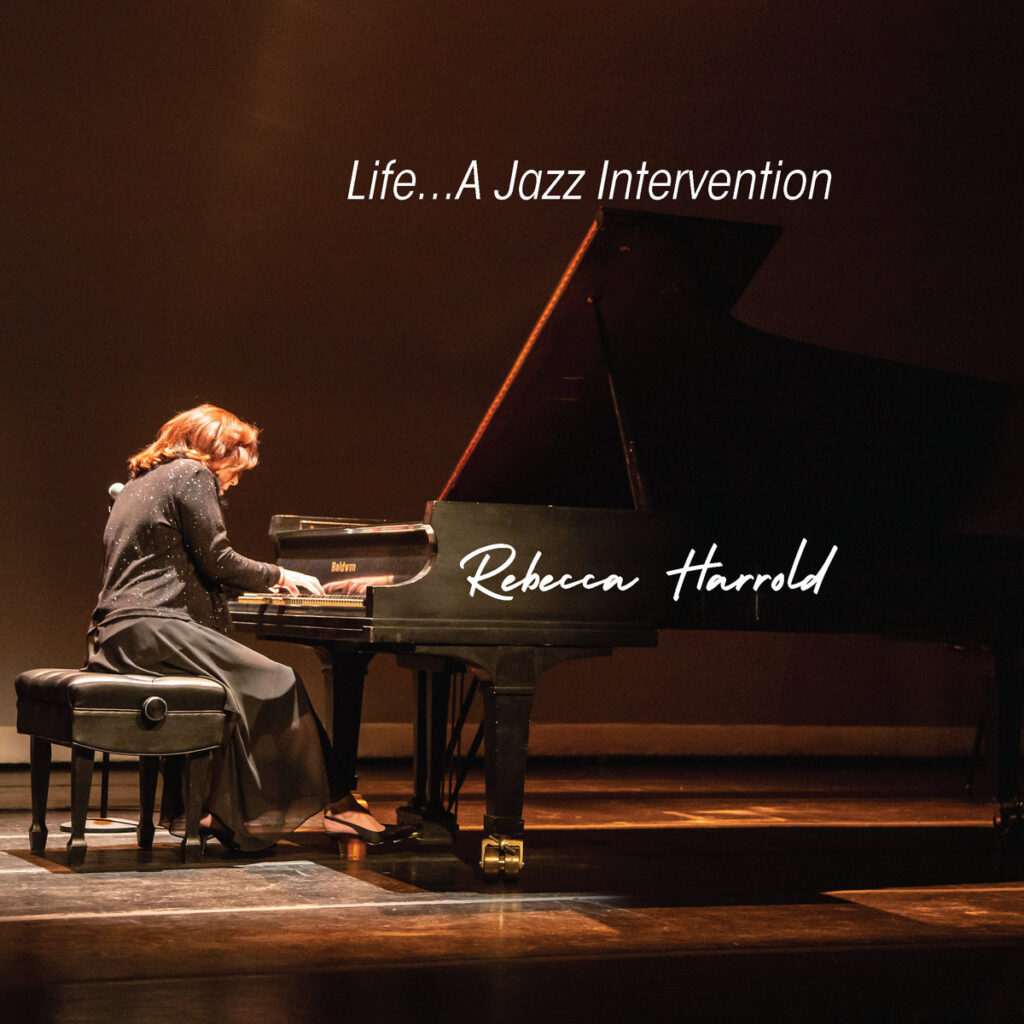
Now, I’m shifting gears to Life… A Jazz Intervention by Rebecca Harrold — an expressive collection of solo piano pieces that channel the rhythmic energy and emotional fire of jazz.
Discovery & First Impressions
I first discovered Rebecca through my friend Kori Linae Carothers — whose album On a Cold Frosty Morning I recently reviewed. (You can read that one here.) Kori introduced me to Rebecca’s work, and from the moment I started listening, it was clear this was something special.
Rebecca’s journey — from classical piano training to finding her voice through jazz — comes through vividly in this EP. Life… A Jazz Intervention feels at once deeply personal and rhythmically alive, with each piece channeling the percussive energy that first inspired her as a young musician. My first impression? This isn’t just solo piano — it’s storytelling through rhythm, texture, and emotion.
Track-by-Track Reflections
Some of the songs featured below are part of the official Reviews from the Aural Realms Playlist on Spotify. Dive in and listen along.
1. Chaos, Maya ( Liminal phase), Transcendence
The album opens with an energetic rush — a quick, up-tempo start that immediately grabbed my attention. To me, the melody feels like a question being asked: urgent, insistent, almost pleading for an answer. It’s hurried and hectic, but in a way that feels alive and purposeful rather than chaotic.
What really stood out is how this piece evolves. Around the three-minute mark, the energy suddenly dissolves into a soft, reflective passage. The shift is so striking that I actually paused, backed up, and replayed it several times just to savor the transition. That moment alone told me this was a special composition. Instead of questioning, the music turns inward — as if the answer has finally arrived and now there’s weight and meaning to contemplate. It feels like the second movement of a larger work, quiet and thoughtful, almost meditative.
By about 5:15, the piece shifts again, this time toward clarity and uplift. The tempo rises, the mood brightens, and what began as questioning transforms into confidence — a renewed outlook, almost proud in tone. The closing melody in particular stirred a strong sense of déjà vu for me, like hearing a familiar memory resurface. I’ll need to ask Rebecca if she intended that, because it was powerful.
This track alone feels like three movements in one — urgency, reflection, and transcendence. It’s a remarkable start, and it’s already earned a place on one of my personal playlists.
2.Chaplin (Charlie Falls in Love)
The title couldn’t be more fitting — this piece feels like watching Chaplin dance across the screen in one of his classic films. I don’t want to suggest Rebecca is imitating him directly, but the playfulness here definitely carries that spirit. At the same time, I can’t help but hear echoes of Vince Guaraldi in her phrasing and touch. The result is pure joy — within the first minute I already knew this track was headed for one of my playlists.
The emotion pouring from Rebecca’s playing is undeniable. If you’re a piano fan like me, this is one of those performances that pulls you in instantly. In fact, I caught myself just bobbing along, forgetting to jot down notes — always a sign that the music has truly captivated me.
Unlike “Chaos, Maya,” which unfolded in distinct movements, “Chaplin” is more of a continuous stream. At over nine minutes long, it never once overstays its welcome. The flow is natural, playful, and alive with energy. If the first track felt like a journey of questions and answers, then this one feels like action — a joyful, celebratory response to life itself.
Bravo, Rebecca. This is a piece that radiates happiness and makes me fall in love not just with the music, but with the sheer joy behind it.
3. Lonely Recon
This piece takes the shape of a gentle waltz, carrying the kind of swaying rhythm that feels both familiar and personal. Rebecca described it as “how isolation sounded” to her, and while I can only assume she’s referencing the pandemic, the sentiment rings true regardless of the moment. Someone once replied to her, “You demonstrate well that there is a rhythm to everything, including aloneness,” and I couldn’t agree more. The phrase she uses — “lonely rhythm” — captures it perfectly.
Compared to the first two expansive tracks, “Lonely Recon” is shorter and more contained, but it doesn’t feel lacking in any way. Instead, it’s a compact expression, joyful in its completeness.
And yes, while I’d still rank the first two songs as my personal favorites so far, this one sits proudly in third place. But let’s be honest — bronze still means you placed, and in this case, it’s a very good bronze indeed.
4. Soleil
Ah, this one immediately caught my ear with its playful shifting between what sounds like 3/4 and maybe 6/4 time — like a dance that can’t quite decide on one rhythm, and that’s exactly what makes it so engaging. It feels like a musical roller coaster: climbing, falling, swaying, then pulling you along again.
The title Soleil — French for “sun” — couldn’t be more fitting. The melody radiates warmth, like beams of sunlight filtering through shifting clouds. There’s brightness here, but also movement, as though Rebecca is capturing not just the steady glow of the sun but the way it changes throughout the day — the slow rise, the sudden bursts, the playful interplay of light and shadow.
For me, it’s less about simply “basking” in the sun and more about the feeling of being lifted by it. The rhythm keeps you suspended, almost weightless, like sunlight dancing across water. A refreshing and joyful piece, and one that adds a completely different shade of light to the overall arc of the album.
5. Solitaire Emotion
This one immediately transports me somewhere specific: not a chain like Starbucks, but a real coffee house — the kind tucked away in Seattle, or maybe a quiet little café in some hidden village. A place where time slows down, where you can sit by yourself and let the world drift by while music like this fills the room.
The title makes me think — is this Rebecca’s nod to Thomas Dolby? Because in my head, I can’t help but hear that famous line from She Blinded Me with Science: “It’s poetry in motion…” Only here, it feels like the words should be “Solitaire Emotion.” That same kind of lyrical rhythm is at play, but in Rebecca’s own unique voice.
Whatever the inspiration, it hooked me right away. There’s an intimacy in the phrasing, a quiet kind of confidence that makes the piece linger long after it ends. And yes — this one is absolutely going on my playlist.
Final Thoughts
I’m honestly surprised by how much I enjoyed this album. And please don’t take that the wrong way—that’s not a knock against the music. I like jazz, but it’s not usually my go-to genre… unless I’m sitting somewhere reading and trying to clear my head. In that context, I realize jazz is one of my go-to genres, and this album reminded me why.
One of the things that stood out most was Rebecca’s use of polyrhythms—the layering of two different rhythms at the same time. It’s not just a technical flourish; it gives her music this wonderful conversational quality, as if one hand is asking a question while the other is answering. At times it feels restless, at others reflective, but always engaging.
I know the greats—Armstrong, Ellington, Miles, Coltrane, Holiday—and I’ve long enjoyed more contemporary voices like Diana Krall and Norah Jones. After this listening experience, I’m adding Rebecca Harrold to that list. Her music doesn’t just pay homage to jazz traditions; it pulls you into her personal journey and leaves you with something to hold onto long after the last note fades.
Artist Interview
Every album has its own story — from the places that spark inspiration, to the improvisations that take on a life of their own, to the unexpected moments that shape the final work. To give us a glimpse into that journey, I asked Rebecca a few questions about Life… A Jazz Intervention and what comes next in her musical path.
Q1. Your liner notes describe how jazz reignited your love for music after years of classical training. What is it about jazz that continues to inspire you creatively today, compared to the structure of classical music?
Q2. You mention this EP is a preview of your larger project Life… A Jazz Intervention, Take 2. How do you see that bigger project building on the ideas you introduced here?
Q3. Polyrhythms and percussive textures play a big role in this EP. How do you approach writing pieces that balance technical rhythmic complexity with emotional expression?
Q4. Looking back on your journey — from that first jazz concert with your brother to recording this EP — what advice would you give young musicians searching for their own “spark” in music?
About the Artist
Rebecca Harrold is a genre-fluid pianist, vocalist, composer, and collaborator whose career bridges classical, jazz, blues, rock, soul, and new age. Originally from Cleveland, Ohio, she spent many years as a pianist and singer with the Playhouse Square Foundation, creating innovative multimedia performances. She went on to serve as principal pianist for the Boston Ballet for two decades, while also holding staff positions at Berklee College of Music and the Boston Conservatory Dance program, before later relocating to Bentonville, Arkansas.
Her versatility has led her from IRNE award–winning productions—such as Stephen Schwartz’s The Baker’s Wife—to performing as a featured vocalist with Faith in Action, whose work was highlighted on WGBH’s Basic Black. She has also toured Europe, presenting her own original music.
As a solo artist, Rebecca has released acclaimed albums like The River of Life (produced by Will Ackerman) and its sequel The Tree of Life, both praised for their lush piano textures and expressive vocals. Her single Chorean, a tribute to Chick Corea, reflects her deep connection to jazz and her talent for improvisation.
In addition to her performances and recordings, she has directed music for children’s theater and school programs, and continues to mentor and accompany young musicians in both composition and ballet accompaniment.
Learn more about Rebecca Harrold and her music
✨ Want Your Music Reviewed? ✨
Reviews from the Aural Realms explores music that moves us and tells a story. If you’d like your own project featured with the same care and attention, I offer professional music reviews and promotional materials through Fiverr.


2 thoughts on “Life… A Jazz Intervention by Rebecca Harrold”