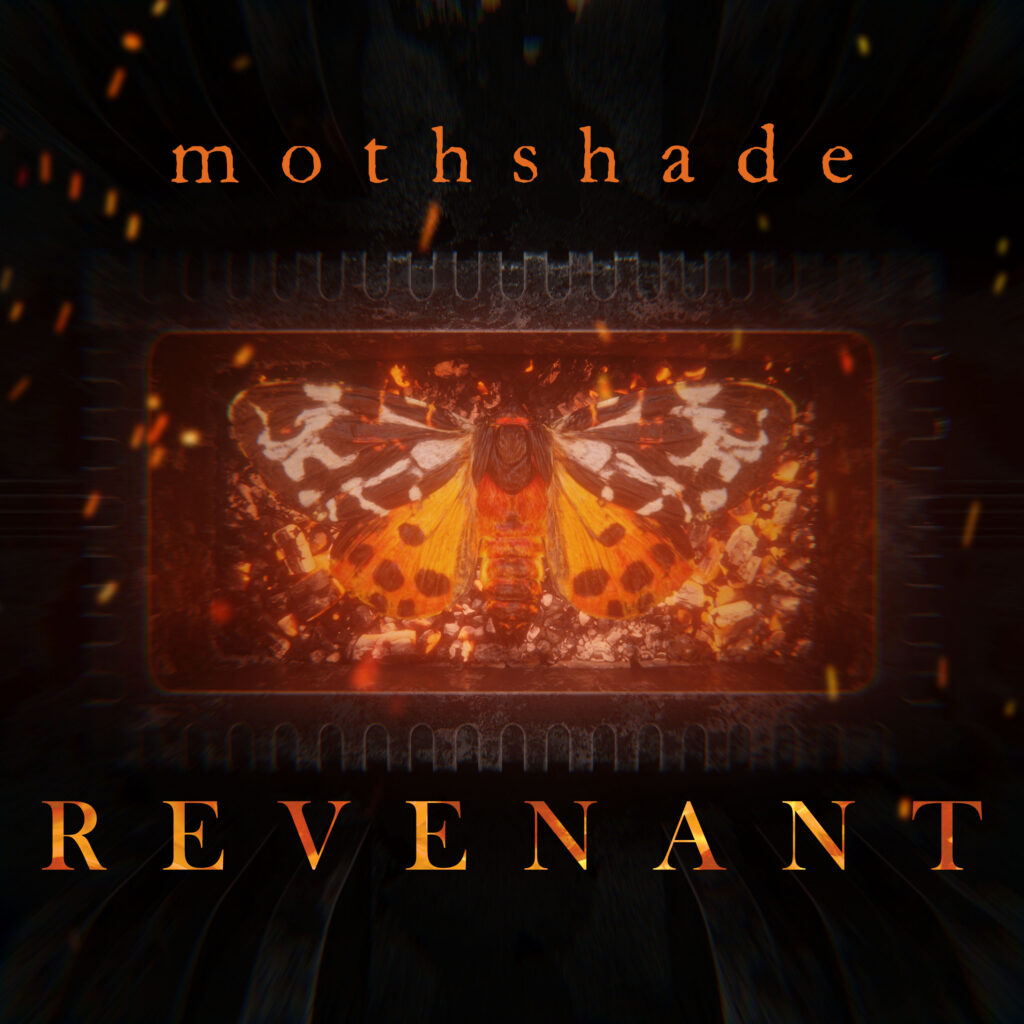
REVENANT by mothshade
Welcome back to Reviews from the Aural Realms, a series from Other Worlds Than These where I explore music that moves me—emotionally, creatively, and sometimes even spiritually.
In my last review, we talked about Paint Them Black by Rosewood Boulevard.
This week, we’re covering REVENANT by mothshade.
Discovery & First Impressions
Coming into REVENANT, I wasn’t entirely sure what to expect—but after spending time with it, one thing became immediately clear: this is not an album content to sit quietly in the background.
This marks the second full-length release from mothshade, and notably the first to incorporate guest musicians into what has otherwise been a deeply personal, largely solo-driven project. At its core, REVENANT explores themes of identity—specifically the idea of reconstruction and deconstruction. The artist described it to me as an emotional take on the Ship of Theseus: how much of who you are remains when you’ve replaced yourself piece by piece over time?
That concept alone sets the tone for the entire listening experience.
Track-by-Track Reflections
🌀 Some of the songs featured below are part of the official Reviews from the Aural Realms Playlist on Spotify. Dive in and listen along.
1. rise (feat. Nine Uzelac)
“rise” wastes no time. It comes in punching hard, with percussion that immediately reminded me of something like Native Instruments’ Damage—heavy, cinematic, and aggressive in all the right ways. I love that sound, and it sets the tone instantly.
As the track progresses, Nina Uzelac’s cello work begins to emerge within the darker textures of the arrangement. It adds a cinematic depth to the piece—subtle at first, but incredibly effective as it weaves into the atmosphere.
Structurally, this is a strong opener. Distinct sections, but all cohesive.
What’s interesting, especially after going back through the lyrics, is how this track sets the starting point of the album’s identity arc—this is the defiant self. The version of you that refuses to break.
This is the “I will not be replaced” moment… before everything begins to unravel.
The breakdown near the 4-minute mark with the cello over darker textures is a great shift—cinematic, controlled, and then building back toward a strong finish.
A really solid opening statement.
2. ashes to ashes
This one grabbed me immediately as well.
Great intro, and once the vocals come in, it just locks in. The blend of guitar, industrial elements, and vocals is tight—nothing feels out of place.
Honestly, this is one where I just had to sit back and enjoy it. Not everything needs to be overanalyzed.
That said… thematically, this is where things begin to crack.
The defiance from “rise” starts to collapse inward here.
Lines about identity, decay, and self-questioning make this feel like the first real fracture in the album’s psychological structure.
It’s a banger—but it’s also the moment where the “self” starts to destabilize.
3. parasite (feat. Nicole Trinchero)
With a slower, more controlled opening before the rhythm section begins to build. Nicole Trinchero’s acoustic drum performance adds a grounded, organic layer that contrasts nicely with the industrial elements.
And once it does—yeah, head’s moving again.
One thing I’m consistently noticing (and loving) is the attention to structure. There’s variation in the bars, shifts in patterns—nothing feels copy-pasted. When repetition is used, it’s intentional.
Now thematically, this is a major turning point.
The “enemy” is no longer external — it’s inside.
This track embodies that idea perfectly. The parasite isn’t something attacking you… it’s something living with you.
That’s a huge shift in the album’s identity narrative.
4. echo chamber (feat. Adriana Cappucci)
Coming off the first three tracks, this one didn’t hit me quite as hard initially.
Not a bad song at all—just one of those moments where you’re riding a high and something lands a bit softer.
That said, Adriana Cappucci’s acoustic drum work adds a human pulse beneath the electronic textures, giving the track a subtle but important sense of movement., and there are some really interesting textures here—especially that metallic, airy arpeggio behind the melody.
Interestingly, the second half grabbed me more than the first.
Conceptually, though, this track is important:
This is where identity becomes recursive — trapped in its own feedback loop.
An echo chamber isn’t just sound—it’s self talking to self, endlessly.
5. recovery
This one builds slowly, starting softer before layering in more elements.
Eventually it kicks in, and I like the transitions happening throughout—especially the way the pre-chorus crashes in.
There’s a push and pull here that works well musically.
Thematically?
This is where things get murky.
Is this healing… or is it just another form of control?
That ambiguity sits right at the core of the track.
6. echo
This one feels more cinematic right from the start.
Shorter track, softer tone—and honestly, I found myself thinking this might have worked earlier in the album sequencing. I may experiment with that on another listen.
But as a piece, I like it.
Conceptually, it fits as a moment of silence after chaos:
When the noise disappears… what’s left?
And the answer here feels uncomfortable.
7. faultline
I like the opening tone here—there’s a vocal effect that reminds me of a kind of “radio transmission” feel. Maybe not exactly that, but you’ll know what I mean.
Catchy bassline, solid rhythm.
But I’ll be honest—this is where I started feeling like I wanted something different. Not because the song is bad—it isn’t—but because the album has established a strong identity, and my brain was craving contrast.
And that’s the challenge:
staying cohesive without becoming predictable.
That said, the piano outro is a really nice touch.
Conceptually, this is the moment of realization:
where the fracture began… and why.
8. down below
Now this is interesting.
Because this track feels like exactly what I was wanting in the previous one.
The tone, the structure—it clicked for me immediately.
And yeah… this one’s going on the OWTT playlists.
There’s also a noticeable similarity in vocal tone to the previous tracks—which at this point feels intentional.
Something deeper has taken control.
That’s the vibe here.
9. sugarcoat
By now, I’m fully in the album.
That “radio/filtered” vocal tone has been consistent across several tracks—I’m assuming that’s intentional, and it ties everything together.
I definitely need to go back and read all the lyrics (which I now have), because this really feels like a continuous internal narrative.
This one is competing with “ashes to ashes” for favorite track.
Structurally strong, emotionally strong—and at this point I’m just in it.
10. stay
This one continues that immersive feeling.
I can absolutely see myself throwing this album on while working and just letting it run.
The acoustic transition is a nice touch, and when the industrial elements come back in, it builds into a solid crescendo.
Thematically:
This is survival… without resolution.
“I’m still here” — but not necessarily whole.
11. hunger (feat. Giovana Teixeira)
This one opens with a haunting tone, and it stays there.
Slower, darker, more oppressive.
The lyrics here are some of the darkest on the album.
This feels like full inversion — the self becoming the thing it feared.
It’s uncomfortable… and that’s intentional.
12. erase
Now this one stands out immediately.
The intro leans more techno than industrial, which is a nice shift.
Then the chorus hits—and yeah, I dig this track a lot.
This is probably my third OWTT playlist addition.
I especially love the second half where things slow down before ramping back up again near the end.
Conceptually:
This is the collapse — identity dissolving completely.
13. sleepwalker
This one started strong for me, but then blended into the surrounding tracks a bit.
Nothing wrong with it—it just didn’t stand out as much on first listen.
Which sometimes happens on dense albums like this.
14. empty frame (feat. Nicole Trinchero)
This one has some really strong transitions—especially into the chorus and back into the verse.
There’s also a horn-like tone in the background that caught my ear.
Not a bad track at all, but again I found myself wanting something slightly different at this point in the album.
The slow fade works well.
Conceptually, though:
This is one of the most important tracks — the “self” is now just a shell.
An empty frame… still moving.
15. residue
And now the finale.
This one slows everything down—acoustic guitar, almost western tones, soft piano.
It feels like a coda.
But not necessarily a resolution.
More like… what’s left behind.
Is it closure?
Or is it a warning?
Maybe even setting up something beyond this album.
Final Thoughts
REVENANT is not a passive listening experience.
This is an album that asks something of you. Not just your attention—but your willingness to sit with discomfort, contradiction, and the slow unraveling of identity. And the more time I spent with it—especially revisiting the lyrics after that first listen—the more I began to see what’s really happening beneath the surface.
This isn’t just a collection of industrial or electronic tracks.
This is a process.
A progression.
A deconstruction.
What starts as resistance in the opening moments gradually shifts inward—fracturing, questioning, and ultimately dissolving the idea of a stable self. By the time you reach the latter half of the album, you’re no longer dealing with an external struggle. You’re dealing with something internal… something intertwined… something that may no longer be separate from who—or what—you are.
And that’s where the album’s core concept truly shines.
The idea of identity as something fluid—something that can be rebuilt, replaced, or even lost entirely—runs through every layer of this record. Not always explicitly, but consistently. Subtly. Sometimes uncomfortably.
There were moments in my first listen where I found myself pulled completely in—tracks like ashes to ashes, parasite, down below, and erase immediately stood out and earned a place on my OWTT playlists. Those are the tracks that hit that perfect balance of structure, atmosphere, and emotional weight.
At the same time, there were stretches where I found myself wanting a bit more variation—not in identity, but in contrast. And that’s a delicate balance. Because the very thing that creates cohesion in this album—its consistent tone and sonic language—is also what can make certain moments blend together on a first pass.
But that’s also the kind of album this is.
Not one that reveals everything immediately… but one that settles in over time.
One that benefits from repeat listens.
One that, much like its central theme, changes depending on how you approach it.
Sonically, it walks a line between industrial grit, cinematic atmosphere, and emotionally driven songwriting. And when it locks in—when all of those elements align—it’s incredibly effective.
There’s also something to be said about the personal nature of this project. Even with the addition of guest contributors, this still feels deeply introspective—like you’re hearing fragments of something internal being processed in real time. Not polished into perfection, but presented as something raw, evolving, and honest.
And that honesty matters.
Because at its core, REVENANT doesn’t try to give you answers.
It doesn’t resolve cleanly.
It doesn’t rebuild what was broken.
Instead, it leaves you with something more unsettling—and more interesting:
The question of what remains… after everything has changed.
And whether that version of yourself is still you.
Artist Interview
Question 1:
REVENANT explores identity in a way that feels fluid—almost like an emotional “Ship of Theseus.” At what point during the creative process did that concept fully reveal itself to you, and did it change how you approached the later tracks on the album?
Answer:
“That idea came through maybe halfway, or close to, during the writing process. I was
reflecting on a lot of the lyrics and rewriting things, trying to figure out what I was
trying to say across multiple songs. The idea struck me as a reflection on identity and
how it can change as you go through life. Sometimes it changes for the better,
sometimes not – and the core idea was rooted in my personal journey of recovery.
Discovering this theme really helped sharpen the edge for the rest of the tracks, and I
went back and rearranged and edited things to make sure the album as a whole was
cohesive. “
Question 2:
You mentioned that much of your work comes from experimentation and atmosphere. When building a track for REVENANT, do you typically start with a sound, a mood, or a narrative idea—and how do you know when a piece has “found itself”?
Answer:
This is interesting because it’s always a mix of things. Sometimes it starts with a guitar
idea, or a synth idea or a rhythmic idea. Having worked a bit as a composer and written
lots of instrumental music, my default workflow is always to chip away at that first. I
tried to write some of the lyrics for this album first and let those dictate how I
approached the instruments. This method worked well, and contributed to the
emotionally heavier tracks on the album – stuff like parasite, echo chamber, hunger…
But other tracks were built around a different seed – like down below or rise, which
started rhythmically first. Knowing when a piece has found itself is a whole different
aspect of the artform – I’m guilty of overworking something forever! There is definitely
a moment when you listen back to something and it just “clicks.” Sometimes that
moment happens quickly and sometimes it requires going down a bunch of different
paths first. It’s different for every track.
Question 3:
This album introduces guest musicians into what has largely been a solo project. How did bringing in other performers—like cello and vocal collaborators—change the way you think about your sound moving forward? Do you see this becoming a bigger part of mothshade going forward?
Answer:
I really enjoyed bringing in guest musicians – Nina on the cello and Nicole, Adriana,
and Giovana on drums. At first it was just the drums – I knew I wanted some contrast
between my programmed, drum-machine drums and the acoustic sounding drums,
and brining in human performances really helped with that. It’s also an instrument I
have yet to learn, so I have a deep respect for drummers and am always fascinated
with what they can bring to a track. The cello part on rise, I had a programmed and
sample library sound but I was really interested in hearing how a human performance
could elevate the idea I had written. It was maybe a little unorthodox – two long
sustained lines that are sort of out-of-tune with each other, but Nina performed them
beautifully and it really encapsulates the tone I wanted – which was something
unstable, eerie, ‘almost right but not quite.’
Every time I hire a guest musician, I am floored with what they can do. I think
collaboration can be such a huge boost to a song! It brings in influences and styles
that I may never have come up with myself. I’m not sure which direction the next
mothshade album will go, but I am certainly open to having guests on again. It was a
wonderful experience.
About the Artists
mothshade is a project rooted in exploration—of sound, atmosphere, and identity. At its core, it is a deeply personal outlet, built from the ground up as a solo-driven endeavor where composition, programming, and overall creative direction originate from a single vision.
What sets mothshade apart is not just the blending of styles, but the intention behind it. The music doesn’t exist to fit neatly within genre boundaries—it exists to express something internal. Across releases, there’s a clear focus on atmosphere and emotional weight, with each track feeling less like a standalone piece and more like part of a larger evolving identity.
With REVENANT, that identity expands. While still very much a personal project, this release introduces collaboration into the fold, adding new textures and human elements to the sound. Contributions such as Nina Uzelac’s cello work and additional guest performances help broaden the sonic palette while still maintaining the project’s introspective core.
Influences range widely—from heavier, guitar-driven artists to industrial and electronic acts, as well as cinematic composers. But rather than feeling like a collection of references, these elements are absorbed and reshaped into something cohesive and distinct. The result is a sound that feels both familiar and unpredictable—grounded in known textures, yet constantly shifting in execution.
More than anything, mothshade feels like a project in motion. Not fixed. Not static. But evolving—track by track, release by release—into something that reflects both the artist behind it and the ideas being explored within it.
✨ Want Your Music Reviewed? ✨
Reviews from the Aural Realms is all about spotlighting music that deserves to be heard. If you’re an artist who’d like to see your music featured in a future review, I also offer detailed review services on Fiverr — including promo clips for social media.